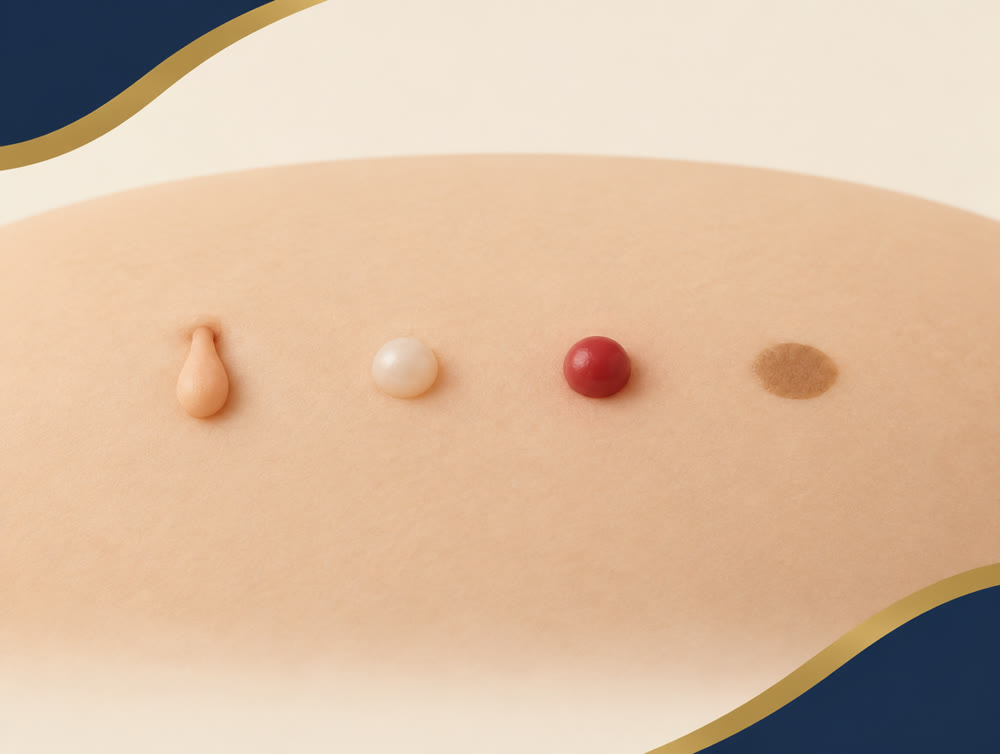
Moles, skin tags, warts, little red spots, rough patches. Skin grows all sorts of things over a lifetime, and the vast majority are completely harmless. But it is normal for one of them to play on your mind. Our approach never changes: first learn what you are looking at, then get anything uncertain properly checked, and only once we are confident something is harmless do we talk about removing it.

Skin tags are soft, harmless growths on a thin stalk. Milia are tiny firm white bumps. Cherry angiomas are the little red dots that arrive with age. Seborrhoeic keratoses are the benign, warty-looking patches that are more common as we get older. Viral warts and verrucas are stubborn but harmless. All of these can be removed in clinic once we are sure that is what they are.
Then there are moles. Most are perfectly happy and stay exactly as they are. A few need a proper look. Dermatologists use a simple checklist called ABCDE: Asymmetry, where one half does not match the other; Border, ragged or blurred; Colour, more than one shade; Diameter, larger than a pencil rubber; Evolving, any change over time. Learning these signs means you can keep a friendly eye on your own skin.
The one rule we never bend: we only ever treat something we are confident is completely harmless. Anything suspicious, new, changing, bleeding or undiagnosed is never frozen. It is seen by a doctor first.
“If it is small and it does not hurt, it can just be frozen off.”
Freezing destroys tissue, so nothing is left to check afterwards. That is exactly why we never freeze anything that should have been assessed first. Benign only, always.

We look at the lesion properly, take photographs for your file, and talk through what it most likely is. If there is any doubt at all, it gets checked by a doctor before anything else happens.
Tag, milia, angioma, wart, keratosis, or a mole that needs a doctor's eyes.
Size, shape, colour, bleeding or itching. Changing lesions are referred, not treated.
Freezing can leave a lighter or darker patch, more so on deeper skin tones. We talk this through first.
A personal history of skin cancer, poor circulation, diabetes, cold sensitivity or keloid scarring changes the plan.
Asymmetry, Border, Colour, Diameter, Evolving. Most moles are fine. The ones that change are the ones to show a doctor.
A phone photo next to a ruler, every couple of months, shows change you would never notice day to day.
Home removal of tags and warts risks infection and scarring. One quick visit is safer.
Once a treated spot has healed, daily SPF on the area prevents it darkening.
Three steps, in that order, every time. We will never skip the middle one.
A proper look in clinic, and a plain explanation of what it most likely is. Educational, never a diagnosis.
If a mole is bleeding, painful, changing quickly, or you have a personal history of melanoma or skin cancer, we will not treat it. We send you straight to your GP or a dermatologist to be seen properly and quickly. That is the honest, safe thing to do.
A fine, precise jet of cold freezes away small benign blemishes in seconds, sparing the healthy skin around them. Quick, tidy and remarkably satisfying. Most need one visit. Stubborn warts and verrucas may want a couple.
Your personal plan and prices are built for you at your consultation. This is the toolkit, not the bill. Treatment prices are on each treatment page and on Prices.
Most lumps and bumps are nothing at all, and knowing that for certain is worth a lot. If a spot has been playing on your mind, bring it in. We will look at it properly, get expert eyes on it if it needs them, and only ever remove what we know is harmless, if you want it gone.
Safe always beats quick.
Most benign blemishes are removed in one short appointment and priced per visit. If you are already a KB member, KB VIP applies, 10% off. Yours is built for you at your consultation, and a membership is only ever suggested if it is the sensible way to pay for the plan you already have.
A short, cold sting for a few seconds, then it is done. Most people manage comfortably without numbing.
For most people it is a little redness and a scab that heals cleanly. A change in pigment where the spot was is possible, more so on deeper skin tones, and scarring is rare but possible if a scab is picked early.
We look, and anything uncertain is referred to your GP or a dermatologist for a proper assessment. We never freeze anything undiagnosed.
Usually one. Stubborn warts and verrucas may need a couple, and we tell you honestly what to expect.
A skin consultation with an advanced skin therapist, £50, includes a proper look and the Observ skin scan. Anything uncertain is referred before anything is treated.
Book your consultationAnswer eight quick questions and read what is likely going on with your skin, and what to ask us.
Take the skin quiz